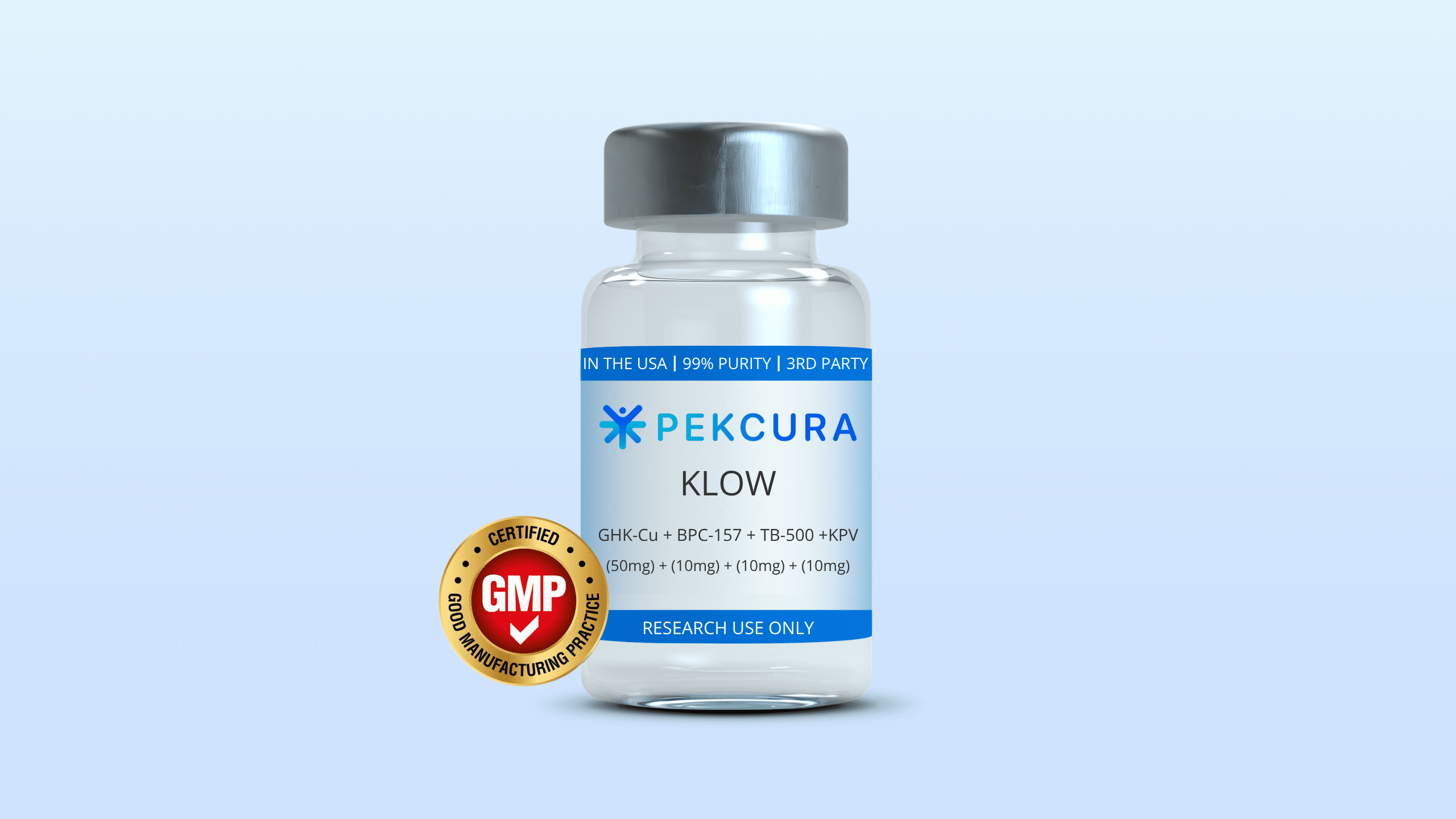
What is KLOW Blend?
The KLOW blend is a research-oriented formulation composed of four distinct peptides: GHK Cu, TB-500, BPC 157, and KPV. Each constituent is characterized by unique physicochemical properties and mechanistic roles relevant to tissue modeling and molecular biology studies.
GHK-Cu is a naturally occurring copper-binding tripeptide that forms a stable square-planar complex with Cu²⁺ through coordination with histidine, glycine, and lysine residues (Pickart, Vasquez-Soltero, and Margolina 2012). This complex is redox-inactive, making it a safe and effective molecular vehicle for delivering bioavailable copper in experimental settings. GHK-Cu has been shown to modulate the expression of thousands of genes related to extracellular matrix (ECM) turnover, oxidative stress responses, and proteostasis through its interaction with the ubiquitin-proteasome system (Pickart and Margolina 2018; Pickart, Vasquez-Soltero, and Margolina 2015). These characteristics suggest a broad utility for GHK-Cu in studies of tissue regeneration, cellular repair, and gene expression modulation.
TB-500, a synthetic peptide modeled after the active sequence of thymosin β4, shares structural features with its parent compound but has a more targeted molecular footprint (Rahaman et al. 2024). In vitro and in vivo analyses highlight its primary metabolite, Ac-LKKTE, as exhibiting the most pronounced activity related to cellular repair, with other metabolites such as Ac-LKK and Ac-LK exhibiting longer persistence but reduced bioactivity. TB-500's structural similarity to thymosin β4 supports its inclusion in research exploring cytoskeletal remodeling, angiogenesis, and extracellular signaling (Morris et al. 2010).
BPC 157, a stable pentadecapeptide derived from a gastric cytoprotective protein, is notable for its resistance to proteolytic degradation and acidic conditions, making it particularly advantageous for preclinical modeling (Józwiak et al. 2025). BPC 157 modulates multiple cellular pathways, including NO signaling, VEGFR2-mediated angiogenesis, and antioxidant defenses (Seiwerth et al. 2021). Preclinical studies have demonstrated its capacity to promote collagen synthesis, neovascularization, and matrix remodeling in various tissue types (Seiwerth et al. 1997; Vukojević et al. 2021). Its pharmacokinetic profile indicates rapid absorption and widespread tissue distribution, with no evidence of significant central nervous system accumulation (Józwiak et al. 2025).
KPV (Lys-Pro-Val) is a naturally occurring tripeptide derived from the C-terminal sequence of α-melanocyte-stimulating hormone (α-MSH) that inhibits NF-κB and MAPK inflammatory signaling pathways independently of melanocortin receptor activation (Dalmasso et al. 2008; Land 2012). Cellular uptake is facilitated by the H⁺-coupled oligopeptide transporter PepT1, through which KPV accumulates intracellularly and suppresses downstream pro-inflammatory cytokine expression, including TNF-α, IL-6, and IL-8 (Dalmasso et al. 2008). KPV has been investigated as a research tool in models of intestinal inflammation, including in targeted nanoparticle-based delivery systems (Xiao et al. 2017).
References
Dalmasso, G., Charrier-Hisamuddin, L., Nguyen, H. T. T., Yan, Y., Sitaraman, S., & Merlin, D. (2008). PepT1-mediated tripeptide KPV uptake reduces intestinal inflammation. Gastroenterology, 134(1), 166–178. https://doi.org/10.1053/j.gastro.2007.10.026
Józwiak, M., Bauer, M., Kamysz, W., & Kleczkowska, P. (2025). Multifunctionality and possible medical application of the BPC 157 peptide—Literature and patent review. Pharmaceuticals, 18(2), 185. https://doi.org/10.3390/ph18020185
Land, S. C. (2012). Inhibition of cellular and systemic inflammation cues in human bronchial epithelial cells by melanocortin-related peptides: Mechanism of KPV action and a role for MC3R agonists. International Journal of Physiology, Pathophysiology and Pharmacology, 4(2), 59–73.
Pickart, L., & Margolina, A. (2018). Regenerative and protective actions of the GHK-Cu peptide in the light of the new gene data. International Journal of Molecular Sciences, 19(7), 1987.
Pickart, L., Vasquez-Soltero, J. M., & Margolina, A. (2012). The human tripeptide GHK-Cu in prevention of oxidative stress and degenerative conditions of aging. Oxidative Medicine and Cellular Longevity, 2012, 324832.
Pickart, L., Vasquez-Soltero, J. M., & Margolina, A. (2015). GHK peptide as a natural modulator of multiple cellular pathways in skin regeneration. BioMed Research International, 2015, 648108.
Rahaman, K. A., Muresan, A. R., Min, H., Son, J., Han, H.-S., Kang, M.-J., & Kwon, O.-S. (2024). Simultaneous quantification of TB-500 and its metabolites in in-vitro experiments and rats by UHPLC-Q-Exactive orbitrap MS/MS and their screening by wound healing activities in vitro. Journal of Chromatography B, 1235, 124033.
https://doi.org/10.1016/j.jchromb.2024.124033
Seiwerth, S., Milavic, M., Vukojevic, J., et al. (2021). Stable gastric pentadecapeptide BPC 157 and wound healing. Frontiers in Pharmacology, 12, 627533.
https://doi.org/10.3389/fphar.2021.627533
Seiwerth, S., Sikiric, P., Grabarevic, Z., et al. (1997). BPC 157’s effect on healing. Journal of Physiology (Paris), 91(3), 173–178.
Vukojević, J., Milavić, M., Perović, D., et al. (2021). Pentadecapeptide BPC 157 and the central nervous system. Neural Regeneration Research, 17(3), 482–487. https://doi.org/10.4103/1673-5374.320969
Xiao, B., Xu, Z., Viennois, E., Zhang, Y., Zhang, Z., Zhang, M., Han, M. K., Kang, Y., & Merlin, D. (2017). Orally targeted delivery of tripeptide KPV via hyaluronic acid-functionalized nanoparticles efficiently alleviates ulcerative colitis. Molecular Therapy, 25(7), 1628–1640. https://doi.org/10.1016/j.ymthe.2016.11.020
More Information
Product Usage
Top Research Products

Related Products